
Categories Uncategorized

TURKEY – International Energy Investments Triple
The proportion of direct international investment in the energy sector in Turkey tripled in the first five months of this year compared to the same period in 2017.
This was reported in statements collected by the Anatolia correspondent on the direct international investment of the Ministry of Industry and Technology.
The volume of international direct investment in the energy sector in Turkey during the first five months of 2018 was US $ 649 million, compared to US $ 202 million in the same period of 2017.
International direct investment in Turkey reached US $ 2.1 billion between January and May 2018.
According to data, direct international investment in the energy sector accounted for nearly a third of international investment in the whole of Turkey.
Manufacturing ranked second with $ 416 million, followed by $ 347 million, according to data.
In view of the distribution of international direct investments by country, 64.3 percent of the cash capital flowing to Turkey during the current year was from the European Union (EU) for about $ 1.4 billion, followed by Asia with $ 406 million and the United States by $ 175 million , And $ 172 million from the rest of Europe
For more details,visit the source of news
https://www.aa.com.tr

Categories Energy News
IBC Solar commissions new PV plant, as lira crisis rattles solar market, but is also seen as opportunity
The Turkish subsidiary of German photovoltaic (PV) systems and energy storage company IBC Solar AG has commissioned a turnkey solar energy project with a total capacity of 1.161 MWp in Merkez near the Bulgarian border for Turkish textile company Edirne Giyim Sanayi, according to a press release from IBC Solar.
The ground-mounted PV plant with 4,224 polycrystalline modules was built for the textile company’s own electricity consumption and can cover 70% of its energy demand. With the completion and handover of the PV plant in mid-August 2018, IBC Solar Turkey has completed another large-scale PV project for the commercial direct-consumption of solar energy.
Investment in PV power plants with a self-consumption model is becoming increasingly attractive among Turkish companies amid rising electricity prices, according to the press release.
The plant commissioned for Edirne Giyim Sanayi is expected to produce 1.6 million kWh per year and prevent 916 tonnes of CO2 emissions.
IBC Solar, which is active internationally with numerous regional companies, sales offices, and partner companies in more than 30 countries, targets a 30% increase in international sales in 2018, Senior Vice President Solutions International Albert Engelbrecht said earlier.
Turkish currency crisis concerns spill over to solar market
Meanwhile, the Turkish lira’s freefall has led to investor concern, including on the solar market. The Turkish currency has lost around 40% against the US dollar so far this year over factors including US sanctions against Turkey and Iran, on which Ankara relies heavily for energy imports.
How Turkish PV developers will react remains unclear, although signs of lower levels of development have been visible this year, pv magazine wrote recently.
The first signal the market was experiencing difficulties came from state-owned grid operator, TEIAS, which for reported only 18 MW of new, registered and unlicensed PV capacity in July, compared newly registered unlicensed projects totaling more than 1.1 GW in the first quarter of 2018 and 2.5 GW in 2017, including 1.7 GW grid connected, pv magazine wrote.
In July, the Turkish government last month decided to authorize foreign exchange loans for approved unlicensed PV projects to reduce domestic foreign exchange exposure for investors and developers of PV projects of up to 1 MW.
According to Halil Demirdag, CEO of Turkish developer and PV panel manufacturer Smart Solar and president of Turkish Solar Energy Industry Association GENSED, the crisis may turn into an opportunity for Turkish solar, as it is now being called upon to help the country reduce its dependence on power imports, pv magazine wrote. “Turkey produces about 300 billion kWh of electricity every year, and only 7 billion kWh is [from] solar,” he said.
Demirdag believes the falling lira may also mean lower balance of system costs for solar parks. He also said that Turkey’s new minister of energy has announced that “net metering is coming” and that “every year the ministry will open new permits of 1,000 MW minimum, for next five years.”
Categories Energy News

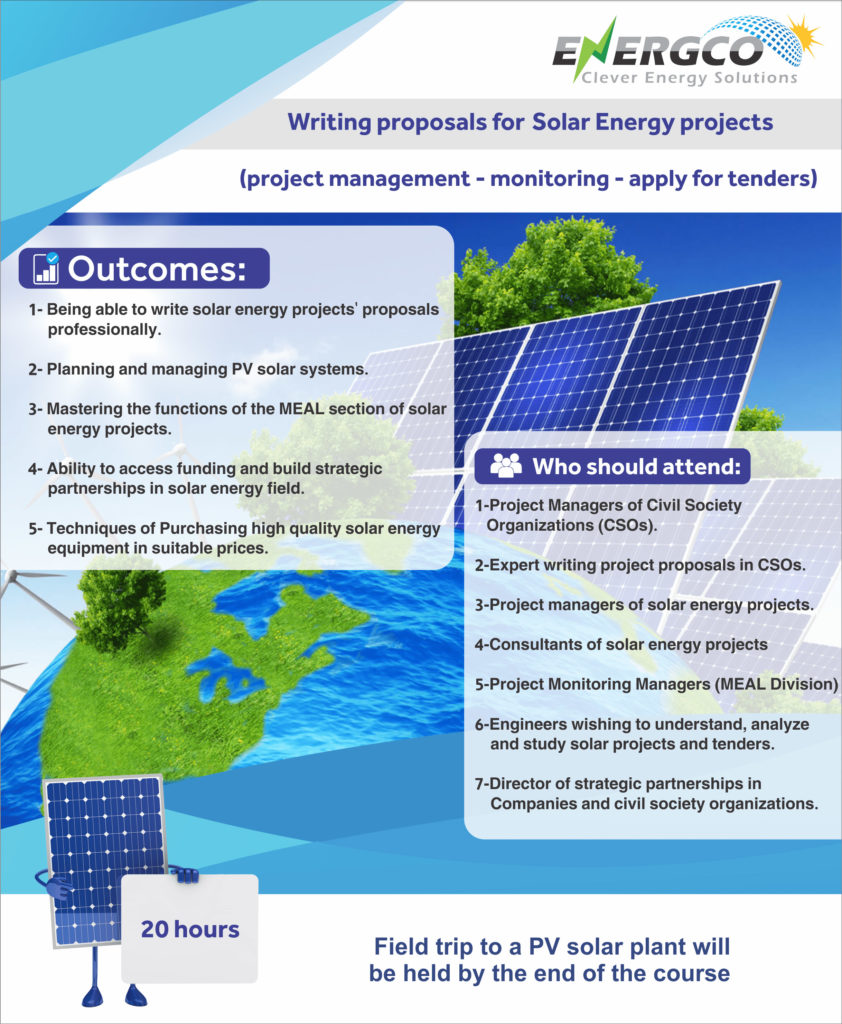
Writing Proposals for Solar Energy Projects
(Project Management – Monitoring – Apply for Tenders)
Training course Overview:
This course will provide 20 hours of training covering important knowledge about photovoltaic (PV) projects. Upon completion of the course, trainees should have; a good understanding of PV system market, PV applications, proposal writing skills of PV solar projects, better understanding of PV project’s tenders, developed financial analysis for PV projects, better understanding of PV system performance analysis, and better planning for Photovoltaic system projects. Field trip to a PV solar plant will be held by the end of the course.
Training course Goals:
- Understand the components and types of PV solar energy systems.
- Get familiar with the tenders of solar energy projects and learn the professional submission of the applications.
- Learn the factors affects the projects’ financial aspects and developing the budget of the project.
- Monitoring, Evaluation and Learning for Solar Projects (MEAL)
- Ways to get funding from international organizations for solar projects.
- Learn how to establish the right public and private partnerships for professional implementation of solar projects.
- Learn how to design and analyze a practical PV project (such as PV systems for Hospitals).
Training course Outcomes:
- Being able to write solar energy projects’ proposals professionally.
- Planning and managing PV solar systems.
- Mastering the functions of the MEAL section of solar energy projects.
- Ability to access funding and build strategic partnerships in solar energy field.
- Techniques of Purchasing high quality solar energy equipment in suitable prices.
Who should attend:
- Project Managers of Civil Society Organizations (CSOs).
- Expert writing project proposals in CSOs.
- Project managers of solar energy projects.
- Consultants of solar energy projects
- Project Monitoring Managers (MEAL Division)
- Engineers wishing to understand, analyze and study solar projects and tenders.
- Director of strategic partnerships in companies and civil society organizations.
Course Language:
English
Course cost:
1950 €
Location
Gaziantep
Categories Uncategorized

IFRI-SOL the Tunisian photovoltaic panels producer with a production capacity of 200 MW and soon 400 MW has finalized the delivery of the 16 MW for a solar power plant in Turkey (Izmir) and it is also preparing to finalize the participation as a panel manufacturer in other plants solar in the same country.
To develop better its strategies, Ifrisol will participate as exhibitor in the most interesting fair in this country which is Solarex Istanbul between 05/04/2018 and 07/04/2018 and presents its current projects including the opening of a factory in Turkey intended for partners who prefer to buy the Ifrisol panel locally with a capacity of 100Mw; decision made by the CEO Mohamed ZROUGA
Now with significant production capacity and product diversification and also the integration of the new PERC technology IFRI-SOL will become a major player in the global renewable energy market.

Turkey’s Minister of Energy and Natural Resources, Berat Albayrak has announced that two tenders for new large-scale wind and solar projects will be held by the end of next summer.
According to a press release from the ministry, the announcement was made on the occasion of the Turkish Energy and Mining Forum in Istanbul.
Albayrak also said that the tender for solar, which is expected to assign another 1 GW of capacity, may also include the deployment of storage, without providing further details. As for the wind power tender, Albayrak said it will assign 1 GW of capacity.
The tenders will be held in the frame of the Renewable Energy Resources Area Project (YEKA), which was initially started for wind power and included solar since last year.
The vast majority of Turkey’s installed power is represented by unlicensed PV installations with a capacity of up to 1 MW. All of the plants included in this category are below 1 MW, or are segmented into 1 MW sub-units.
In the first solar auction held by the Turkish government last year, South Korea’s Hanwha Q Cells and local Turkish firm, Kalyon Enerji were awarded the contract to build 1 GW of solar in Konya, in the south-western edge of the Central Anatolian Plateau, at a price of $0.0699 per kWh.
The tender’s awarded contract included the construction of a 500 MW vertically integrated solar module factory, which Hanwha Q Cells and Kalyon Enerji inaugurated in December.
Categories Solar System

Hive Energy has achieved grid connection for its first project in Turkey. The 10 MW plant began generating power at the end of February, and is expected to generate around 18 million kWh per year.
The project’s US$11 million investment cost was financed by investors in the U.K. With the support of the British Chamber of Commerce in Turkey, Hive Energy established an office in Turkey in 2015, when it was reportedly looking to develop a 50 MW portfolio of projects.
“Throughout the planning and construction phase we worked hard to use local workmanship, materials and services,” said Hive Energy’s general manager for Turkey, Tolga Metin. “This park is an excellent example of how Foreign Direct Investment can have a positive impact on Turkey’s economic growth.”
Turkey installed an impressive 1.7 GW of new solar capacity in 2017, and is poised for another big year in 2018, with a 1 GW tender expected to be issued in the coming months.
Categories Solar System

Categories Solar System
Turkey registers 522 MW of new unlicensed PV capacity in first two months of 2018
Turkey has reached a cumulative registered unlicensed PV capacity of 3.94 GW (AC) as of the end of February 2018, according to new statistics published by the country’s state-owned grid operator, TEIAŞ, which appeared on the twitter account of the company’s general manager, Abdullah Atalay.
Overall, Turkey’s installed power generation capacity has topped 86.1 GW at the end of February. Natural gas and hydropower are the largest energy sources, with 27 GW and 27.4 GW respectively, followed by coal power, which has a generation capacity of around 19.2 GW. Wind power currently has an installed power of 6.5 GW, while geothermal and biomass power facilities have a capacity of 1 GW and 647 MW, respectively.
Official line
In a statement to pv magazine, Atalay said that all of the values provided in the statistics “refer to unlicensed operational power plants”. According to him, 522 MW of new PV systems were connected to the grid in Turkey in January and February alone, a growth trend that, if confirmed over the rest of the year, is likely to lead to stronger growth in 2018.
That the Turkish PV market may have reached or even surpassed 4 GW of registered unlicensed PV, was also confirmed by Kutay Kaleli, president of solar association, Günder, which represents the Turkish Republic in the programs of IEA PVPS (International Energy Agency Photovoltaic Power Systems).
On his Twitter account, Kaleli said, “The latest information we received at the Günder board meeting is that we have passed the 4,000 MW limit last weekend and we now have 4,061 MW of solar.”
In 2017, according to numbers published by TEIAŞ in late January, new PV additions totaled 2.5 GW. Most of this capacity, namely 1.2 GW, was registered in December alone.
Discrepancy
The figures provided by TEIAŞ at the end of January, however, have been questioned by a second Turkish solar association, Solarbaba, which claimed at the time that newly installed PV capacity for 2017 was not 2.5 GW but rather 1.7 GW.
According to the non-profit organization, TEIAŞ included PV projects that were near completion and not yet connected to the grid, on the 2017 spreadsheet. Upon pv magazine’s request to provide more details on the matter, however, the association’s president said he was not willing to further comment.
The European solar association, SolarPower Europe, which also recently reported 1.7 GW of newly installed PV power for Turkey in 2017, told pv magazine that new figures on the Turkish market will likely be provided before the association’s summit, which is scheduled to take place in Brussels next week.
U.K.-based market research company, IHS Markit has said it will also review its statistics on the Turkish market, following the publication of the new figures. “The difference between the official connection numbers of TEIAS and IHS Markit’s market estimation can partly be explained by the fact that TEIAS registers the grid connections, while market numbers of IHS Markit are based on system installations,” IHS Markit analyst, Susanne von Aichberger said in a statement to pv magazine.
“This means that IHS Markit has counted much of the installed capacity that was connected in 2017 in its 2016 number. While IHS Markit had 1.4 GW (DC) of cumulatively installed PV capacity in Turkey at the end of 2016, this cumulative connection number of TEIAS is 0.9 GW (DC) at the end of 2016.”
She continued, “The balance of 0.5 GW (DC) should be added to the number for 2017, if connections are being looked at. However, installation activity seems to have accelerated in the second half of 2017, ahead of the implementation of grid fees on 1 January 2018. IHS Markit will thus increase the installation number for 2017 to over 2 GW (DC).”
Eren Engur, CEO of Turkey-based solar consultancy company, Icarus Enerji-A, which has been operating in the local market for over 16 years, believes the country’s current operational PV is lower than that announced by TEIAŞ.
“Around 3.1 GW have been connected to grid so far,“ he said to pv magazine. This capacity, according to him, does not include the category of projects under the Temporary Acceptance (Geçici kabul) mode, which is the preliminary stage before getting grid connection approval. “Not 100% of the construction is finalized at this stage,” he said.
Rally
Outwith the question of whether installed capacity really has reached 3.94 GW, or whether some of this is still under development, a planned elimination of a grid-fee reduction, which came into effect on January 1, 2018, would have served to support an end-of-year rally.
The fee, which had been increased from 0.0076 TRL/kWh ($0.0026) in 2016 to 0.0256 TRL /kWh in 2017, has been further increased to 0.1025 TRL/kWh (around $0.027) starting from this year.
Despite this planned incentive reduction, developers appear not to have been discouraged, as the Turkish government is still granting a FIT of around $0.13/kWh to unlicensed PV projects.
“The impact of the fee on the FIT, however, may bring to a lower growth this year,” Bilal Eid, an assistant professor at the Department of Electrical and Electronic of the Faculty of Engineering of Turkey’s Hasan Kalyoncu University, and a consultant for solar project developers in Turkey, told pv magazine.
“It is still hard to say how much solar the country will deploy this year, but taking into account the current figures provided by TEIAŞ, it seems like the drop in PV project prices may also play a major role in boosting the market,” he added.
It must be stressed, however, that very few markets currently provide such a high FIT for MW-sized PV projects, and that, although in theory only PV projects up to 1 MW are eligible for this tariff, many solar parks consisting of 1 MW sub-units were built, and are being developed, in Turkey.
The history of PV in recent years has shown stronger end-of-year rallies than the one occurring in Turkey for large-scale solar. As a consequence of this tumultuous development, public entities have serious trouble securing grid-connection and managing the huge volumes of associated data.
Categories Solar System

Categories Solar System
JinkoSolar and Asunim Turkey complete the largest solar power plant in the Aegean Region
Asunim is currently one of the leading EPC companies in Turkey and has so far concluded projects of 140MW with a separate and clear structure committed for long-term O&M commitments. The dedicated international engineering team of Asunim has a long track record of successful systems design and implementation, using cutting-edge 3D modelling and simulation software to correctly elaborate extremely important shading and counter slope calculations.
The power plant in Manisa, Turkey consists of two separate sites that have an outcome of 40.3 MW, built in parallel. One of 19.7MW and the other of 20.6 MW. Both are located in Manisa, Turkey. The systems feature JinkoSolar high-efficiency (PID free) solar modules and REFUsol 40K string inverters operating without the need for fan cooling and with full IP65 protection against humidity and dust. The German company, Solar-Log was the choice for the SCADA system. Operation and Maintenance activities will be covered by Maxima Energy, affiliate but independent O&M Company of Asunim.
“Installing a project on a flat terrain is easier when compared to sites with different slopes. In order to get the highest yield several different studies and calculations were made for this challenging project.” comments managing partner of Asunim Turkey, Mr. Umut Gürbüz .
“We are extremely pleased to see this contract as an outcome of our steadily growing successful partnership with Asunim Turkey over the last years. Asunim Turkey, as a trusted local partner, shares and follows the same highest product and service quality levels that we do also apply within Jinko Solar globally which makes us stronger and helps us to maintain our leadership position in the market.” adds Mr. Gener Miao, Vice President Global Sales and Marketing of JinkoSolar.
Categories Solar System

Spare ribs kevin pork loin magna, adipisicing culpa consectetur meatball dolore doner ham tri-tip sunt kielbasa est. Culpa incididunt tri-tip, porchetta officia occaecat cupidatat swine voluptate proident adipisicing meatball do short loin dolor.Read more Flank jerky cow sirloin strip steak t-bone bacon
Categories Environment