As of the end of June, China’s solar power plant installed capacity exceeded the 100 GW limit and reached 102 GW.
In China, which has 78,70 MW solar power plants as of the end of 2016, the total installed power reached 102.4 GW with the addition of 24.4 GW in just the first six months of 2017.
The People’s Republic of China, which is the first country to exceed the 100 GW installed power limit in the sun, has the world’s most populous population with 1 billion 386 million but has reached 74 watts per capita SPP installed power.
When we look at the solar energy installed power per capita of countries, Germany continues to lead with 510 watts, followed by Japan with 337 watts per capita. Turkey, on the other hand, ranks 35th in the world with an installed power of 1,579 MW and a 20-watt GES facility per capita.
Scientists who have been working for decades to reduce dependence on fossil fuels and produce low-carbon energy are looking for solutions by creating an “artificial sun” in the world with nuclear fusion experiments.
Scientists are trying to combine hydrogen atoms and create helium by fusion by sending 140,000 amps of electricity to the hydrogen gas cloud. This fusion is the force that holds the sun together.
It is stated that such an experiment will not make the world the new sun of the solar system, but it can pave the way for cheap and clean energy. The challenge for scientists is to find a way to do this safely.
China announced that it is conducting a new experiment
China’s Hefei Institute of Physical Sciences is pursuing methods for nuclear fusion that go beyond just splitting atoms and creating power by combining nuclei. In other words, scientists are trying to “fit the sun in a box.”
With the Advanced Superconducting Tokamak Experiment, scientists at Hefei are trying to create an “artificial sun,” that is, a constant temperature as high as the sun. In this context, a new experiment was carried out.
An investment of nearly $900 million was made for the ring-shaped machines called a tokamak, where these experiments were produced. At extremely high temperatures, the Tokamak boils hydrogen isotopes into plasma and combines them to release energy.
China, which has been conducting fusion research since 1958, emphasizes that international cooperation is more important than the competition at this stage. China is a member of the “giant” nuclear fusion project ITER, which is being built in France. The project under construction in France has a budget of 10 billion euros.
China’s responsibility for this project is to produce the components needed for ITER to hold magnetic and withstand temperatures up to 100 million degrees Celsius. ITER, which plans to produce the first plasma in 2025, plans to build a sample reactor that will produce 500 megawatts of energy with 50 megawatts of power.
A new study has uncovered a new way of applying advanced artificial intelligence to cool buildings using renewable energy.
From the Oman Ministry of Higher Education, Research and Innovation, Dr. The research study, led by Maryam Zuhair Al Lawati, is published in the journal Scientific Insights. The research discovered an innovative way to apply advanced artificial intelligence techniques and adapt them to cooling buildings in Oman.
According to the Times of Oman report, the technique uses renewable environmental energies through an intelligent system that integrates these technologies through a specific mechanism. The system, designed by artificial intelligence, estimates the volume and amount of cooling required for the building in summer and winter, and the control system operates the heating system according to the building’s needs, according to the estimates.
Dr. Maryam stated that the idea for the research arose because of the importance of utilizing the renewable energies available in Oman. The research also aims to solve the persistent and persistent problem of refrigeration and air conditioning buildings. According to the studies carried out within the scope of the research, the solar energy used to cool the buildings runs the thermal air conditioner that provides energy to cool the building. Heat is reduced by transferring energy to the ground and utilizing land and geothermal energy.
Dr. Maryam explained that the study findings show that Oman’s buildings rely entirely on electrical energy to cool 100 percent, while the study proved that when solar-based thermal energy is introduced, electrical energy use can be reduced from 100 percent to 23.6 percent per year. The research also showed that the role of geothermal energy is small compared to the percentage of solar energy use, while it was stated that solar energy should be used efficiently in this area.
The giant boat named MS Turanor PlanetSolar, manufactured by the Swiss company PlanetSolar uses renewable energy. It also has the distinction of being the largest solar-powered boat.
The Planet Solar boat, built under the leadership of the University of Geneva, has two separate missions. One of them is to instill environmental awareness by using only solar energy. The second is to undertake ocean research by making a world tour. 3 scientists from the University of Geneva have been trying for a long time to make the Planet Solar boat reach its goals. Scientists travel around the world with the Planet Solar boat to examine the great heat exchange currents created by the currents in the oceans in the atmosphere. The boat, which is fully solar-powered, can reach a speed of 10 km per hour.
PRODUCES 127 HP POWER…
The solar panels of Planet Solar, which are 31 meters long and 15 meters wide, cover an area of 516 square meters. The electricity obtained from these panels can produce a maximum of 127 horsepower. The engine of the boat, whose panels work with an efficiency of 18.8 percent, consumes an average of 20 KW power per hour. This power indicates that a maximum of 60 passengers can be carried on the boat. Source: Solar powered Planet Solar explores the ocean
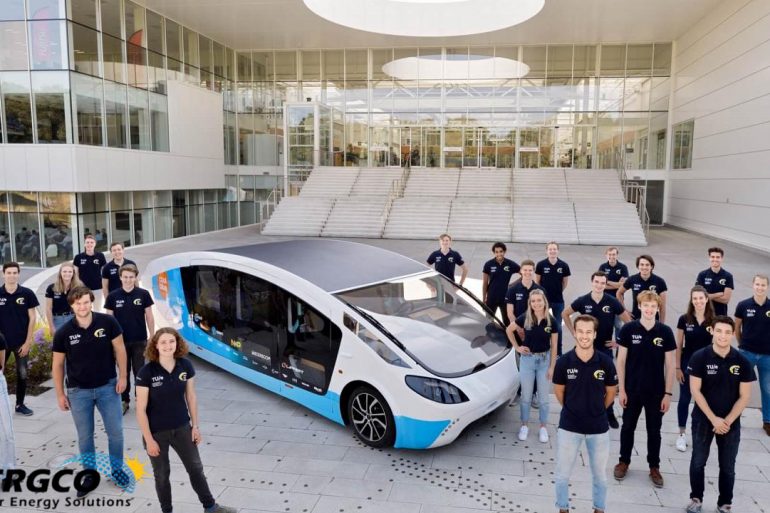
Continuing on the route it started from Spain on the highways of Europe, a custom-built caravan called Stella Vita traveled about 2000 kilometers.
There is an important feature that distinguishes Stella Vita, which means “star of life” in Italian, from other caravans. This trailer never took a break to store gas, hydrogen, or electricity. Because Stella Vita gets the fuel it needs from the solar panels on it.
Developed by 22 students at the Netherlands’ Eindhoven University of Technology, “Stella Vita” is defined as a “self-sufficient house on wheels”. Because inside this trailer, there are all the accessories and rooms that should be in a house, such as a kitchen, bathroom, toilet, double bed, and sofa.
A young team named Solar Team Eindhoven 2021 designed the trailer, which was developed with financial assistance from sponsors. The vehicle, whose testing phase was completed in July, received the necessary permits in September to be able to drive in Europe.
Tijn Ter Horst, 21, one of the young members of the team that brought the project to life, said: “Our aim is to inspire the public and the world vehicle market for a “more sustainable life”. We wanted to show people and companies that life is already possible without harming nature.” says.
Solar panels, wind turbines, hydrogen mechanisms, hydroelectric power plants, and systems that generate electrical energy from sea currents and waves…
While the 2021 United Nations Climate Change Conference (COP26) started in Scotland, the solar panels developed in France and reached the stage of mass production are at the point of breaking new ground in sustainable energy.
Manufactured by Maxeon Solar Technologies, these panels are thinner than a pencil and half the weight of other rooftop solar panels. Thanks to this technology, commercial businesses and houses that cannot be installed with solar panels on their roofs due to excessive weight will be able to benefit from sustainable energy by using solar energy.
Solar panels are the easiest and least expensive to install among other sustainable energy systems. For this reason, many homes and businesses prefer electricity generation via solar panels instead of other systems.
Thanks to the electricity obtained from solar panels, 75 million barrels of oil and 35 million tons of carbon dioxide gas per year are prevented from entering the atmosphere.
Currently, there are very thin solar panels on the market that can be portable or attached to the wall of houses, but this new product produced by French Maxeon has a high electricity generation capacity in a minimum area and is the thinnest solar panel in the world in its field.
Many solar panels on the market currently produced cannot be installed on the roofs of factories, warehouses, workplaces, and some houses, which have very heavy and wide roofs. These thin panels produced by Maxeon are capable of starting a new era in the field of generating electricity from solar energy.
Why do we need lighter solar panels?
The energy spent in houses and apartments, which are the living spaces of people, causes 28 percent of global warming in the world. In addition, solar panels cannot be installed on the roofs of at least 40 percent of commercial buildings due to their weight.
Lightweight solar panels are especially important in terms of being applied to commercial buildings such as factories, warehouses, and workplaces. These new solar panels do not use metal frames and heavy glass surfaces. In addition, the adhesive system that does not require a shelf is another factor that reduces the weight considerably.
When all these are combined, a system that weighs 6 kilograms per square meter and is approximately 60 percent lighter than normal solar panels emerges.
According to research by Maxeon Solar Technologies, only the European market has at least one year of the unoccupied market with lightweight roof systems waiting for solar panels to be installed.
The spokesperson of the company said in a statement that the new design they developed is largely advantageous due to the supply chain, distribution, and rapid assembly.
“This new technology solar panels weight, volume, production and shipping costs are very low. Especially large companies and small business owners can reach their zero-emission targets much faster thanks to these panels.
Maxeon solar panels are manufactured at its headquarters in Porcelette, France, on the Luxembourg-Germany border, and willfully enter the European Union market in 2022.
Glasgow Airport has unveiled its largest solar power plant plan under the airport, as part of its commitment to decarbonize its infrastructure and reach net zero by the mid-2030s.
Glasgow Airport operator AGS Airports said in a statement that the planned 30-acre ground-mounted solar power plant could generate enough power for Glasgow Airport, the airport campus, and neighboring businesses.
While the 15 MW capacity solar power plant is planned to be operational by the summer of 2023, AGS Airports CEO Derek Provan said: “All of our electricity is purchased from 100 percent renewable sources since 2018, but the creation of the solar power plant at Glasgow Airport, It will enable us to produce enough clean energy for both the airport and our neighbors.”
Expressing that AGS has the opportunity to become a test environment for hydrogen and electricity flights, Provan stated that the solar power plant will provide the ability to provide future proof for the increase in electricity demand.
Saying that they will start a green car program for the electrification of airport vehicles, Provan said, “All these will require electric vehicle charging infrastructure. We need to anticipate these changes, and the actions we take today will enable us to meet both the demands of the future and our net zero goals.” said.
Extracting 250 thousand tons of salt from its basins every year, Kenya is one of the leading salt producers in East Africa. Kenya-based companies have managed to reduce their carbon footprints by 25 percent, thanks to their cooperation with Japan.
One of these companies, Krystalline Salt, works with one of Kenya’s largest industrial solar systems. This solar power plant, funded by Japan, provides 1.6-gigawatt hours of clean electricity per year. This makes it possible for the company to overcome the instability of local network supply.
The ecological solution to power cuts
Emphasizing that the biggest problem of the company is energy instability, Dinesh Shikotra, General Manager of Krystalline Salt, said, “We can experience up to five power outages a day, which hinders our production. As a result, we cannot meet the demand”. said
The instability of the grid was forcing the company to invest in polluting and expensive generators until 2016 when the solar power plant was built.
However, Shikotra stated that thanks to Japan, they managed to overcome this problem:
“Using solar energy was actually our dream. We learned about the agreement with the Kenyan and Japanese Governments on the Joint Credit Mechanism. Working closely with them, we were able to get a grant to install this magnificent solar plant here.”
The company’s production capacity has increased
The Joint Credit Mechanism, bilateral cooperation between Africa and 17 other developing countries, is a carbon market mechanism launched in 2013 under Article 6 of the Paris Agreement. It enables Japan to share technologies and resources that facilitate zero carbon emissions worldwide.
The Krystalline Salt solar power plant has enabled the company to increase its production capacity and save on its electricity bill. Some of these savings were invested in social activities such as giving scholarships to students.
Shikotra spoke about the benefits of solar energy:
“Since the establishment of this power plant in 2016, we have saved about 5,000 tons of carbon emissions. We have created more jobs for the local people here, and that has been really positive growth for us.”
Turlock Irrigation District (TID) in Turlock, California, is preparing the country’s first pilot project to cover a section of the water utility’s existing canals with solar panels. Project Nexus is a multi-use solar project that will evaluate water evaporation reduction through mid-day shade and wind mitigation, as well as improved water quality and decreased canal maintenance due to reduced vegetative growth.
TID, the Department of Water Resources (DWR), Solar AquaGrid, and the University of California, Merced collaborate on Project Nexus, a public-private-academic alliance. Project Nexus is set to commence ground this autumn, with completion projected in 2024 at numerous locations within the TID service zone in California’s Central Valley. To cut expenses and promote the region’s sustainable agricultural history, the project will utilise existing TID infrastructure on already-disturbed land. Energy storage will also be implemented to see how storage facilities might help the local electric system when solar power isn’t as good due to cloud cover. The state of California is funding the $20 million project.
TID’s board president, Michael Frantz, remarked, “In our 135-year history, we’ve always sought new initiatives that benefit TID water and electricity consumers.” “While there will always be reasons to say ‘no,’ as California’s first public irrigation district, we aren’t hesitant to forge ahead with experimental projects that have the potential to accomplish our water and energy sustainability goals.”
Project Nexus is considered as a model that might be reproduced elsewhere in California to assist the state meet its water and energy goals. Project Nexus was inspired by an idea given in a recent the University of California research published in the journal Nature Sustainability in March.
According to the UC research, covering all of California’s approximately 4,000 miles of canals might save 63 billion gallons of water each year, enough to irrigate 50,000 acres of agriculture or supply the residential water demands of more than 2 million people. The 13 GW of solar electricity generated annually by the solar panels would be nearly one-sixth of the state’s existing installed capacity, according to the research.
Solar AquaGrid, a Bay Area development business, has been hired by Turlock Irrigation District to serve as project developers and program managers for TID and Project Nexus. Since the beginning of the project, the two agencies have worked together. After commissioning the UC Merced Study in 2015, Solar AquaGrid conceived the concept and has enabled collaboration among the many partners to bring Project Nexus to fruition.
“In an age of growing drought, research and common sense tell us that it’s time to put a stop to evaporation,” said Jordan Harris, CEO of Solar AquaGrid. “We’re pleased to work with the Turlock Irrigation District, the Department of Water Resources, and UC Merced to establish this first-in-the-nation pilot project and bring essential innovation to the Central Valley.” When compared to ground-mounted solar systems, placing solar panels over open canals can result in considerable water, energy, and cost savings, as well as increased efficiency due to an exponential shading/cooling effect. Now is your moment to put all you’ve learned to the test.”
In Portugal, one of the leading countries of the European Union in renewable energy, electricity generation from renewable sources exceeded the country’s total electricity consumption in March.
Heavy rainy and windy weather conditions in the country boosted production at hydroelectric and wind farms last month, according to data from the Portuguese Energy Infrastructure Company (REN).
The amount of electricity produced from renewable sources in Portugal reached 4 billion 812 million kilowatt-hours in March. In the month in question, a total of 4 billion 647 million kilowatt-hours of electricity was consumed in the country. Thus, all of the electricity consumed in the country last month was met from renewable energy.
70 hours of continuous renewable energy generation
In the process that started in Portugal on March 9, all consumption was met from renewable energy sources continuously for 70 hours and no emissions were produced.
On the other hand, according to the Portuguese Sustainable Terrestrial System Association, 1.8 million tons of carbon dioxide emissions were prevented in March thanks to renewable energy production in the country. It has been reported that this amount corresponds to an allowance of 21 million euros in the carbon market.
In addition, in the first quarter of the year, renewable energy production in Portugal met 61 percent of total consumption. Of this amount, 31% was wind, 24% hydroelectric, 5% biomass, and 1% solar power plants.
Portugal met its total consumption from renewable energy sources completely and uninterruptedly for 107 hours in 2016. Check more details on our Facebook page.




 or electricity. Because Stella Vita gets the fuel it needs from the solar panels on it.
 Solar panels, wind turbines, hydrogen mechanisms, hydroelectric power plants, and systems that generate electrical energy from sea currents and waves…

 and 17 other developing countries, is a carbon market mechanism launched in 2013 under Article 6 of the Paris Agreement. It enables Japan to share technologies and resources that facilitate zero carbon emissions worldwide.